Introduction
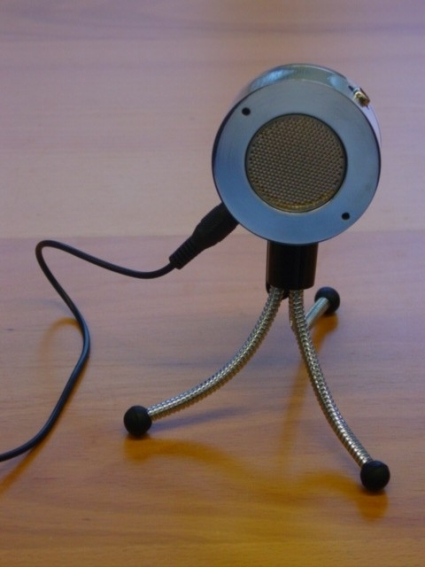
SONOTRACK is a non-invasive measurement system to record, analyze and playback ultrasonic sounds produced by (laboratory) animals. SONOTRACK uses high-end microphones and dedicated hardware which can pick up ultrasound signals in the frequency range of 15 kHz to 125 kHz. The ultrasounds picked up by the microphones are not only converted to audible signals but the “complete ultrasound signal” is also recorded in digital format.
The SONOTRACK software enables the user to analyze the sounds or "animal language" in much more detail than ever before. The software allows very long recording times and uses advanced filtering techniques to remove unwanted background noise. The innovative Ultrasound Vocalizations (USV) detector in SONOTRACK enables automatic detection and counting of ultrasonic vocalizations of your animals in user selectable frequency bands. The batch processing function of the USV detector makes it possible to go through a large amount of measurements and provide you quickly the end points of your experiment.
In addition to the SONOTRACK USV detector, the optional SONOTRACK Call Classifcation software automatically classifies the Ultrasonic Vocalizations (calls) in 15 distinct categories of calls.
The unique and innovative functionality can lead to a further refinement of your research with the following advantages:
- New animal models involving the use of ultrasound as a measure for amongst pain, stress, depression, fear, anxiety, social interaction, sexual related behavior
- Application in the analysis of Bipolar diseases (such as Autism) and degenerative diseases (such as Alzheimers Disease)
- A decrease in the number of laboratory animals by shorter lead times of studies and more consistent and reliable data
- Less discomfort, improvement/monitoring of animal welfare, and better living conditions for laboratory animals by using a non-invasive way of measuring.
How does it work?
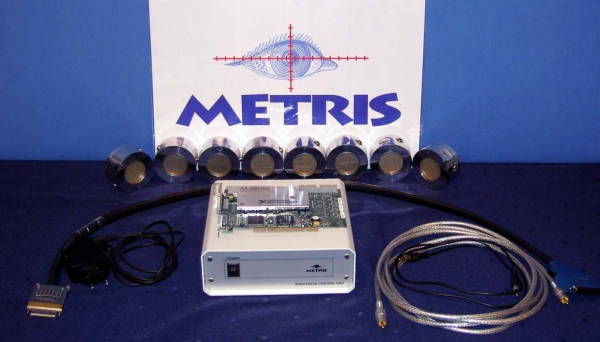 SONOTRACK is a so-called full spectrum recording system. It means that it digitizes and records the whole ultrasound frequency band from 15kHz to 125kHz. In contrast to so-called bat detectors Sonotrack doesn't have to be tuned to a specific frequency range. In applications involving rodents that vocalize over a broad frequency range it is obvious that these bat detectors systems are unsuitable.
The full spectrum recording technique makes it also possible to present the recordings in all kind of graphical presentations such as Sonograms which reveal a lot of information about the actual call or vocalizations of your animals.
Sonotrack is equipped with preamplifiers and anti-aliasing filters that have very high dynamic range which means that without changing amplification it can pick up very weak vocalizations as well as accurately amplify very loud vocalizations. In some popular systems on the market loud signals lead to "signal clipping" of the amplifier, resulting in wide band noise and detoriation of the recorded signal. This problem is often not recognized by researchers and makes manual and automated analysis of the recording very difficult or impossible
Sonotrack uses high-end data acquisition boards to ensure that the analog-to-digital conversion is accurate and precize synchronization between Sonotrack and other system is possible.
Meaning of Ultrasound Vocalizations
Ultrasound vocalizations (USV), sometimes also called Ultrasonic vocalizations are commonly referred to as sounds within the frequency range of 20 kHz - 300 kHz. This frequency range is well above the human range of hearing. However, it is well known that bats, dolphins, rodents and insects produce and hear USV as part of their behavior.
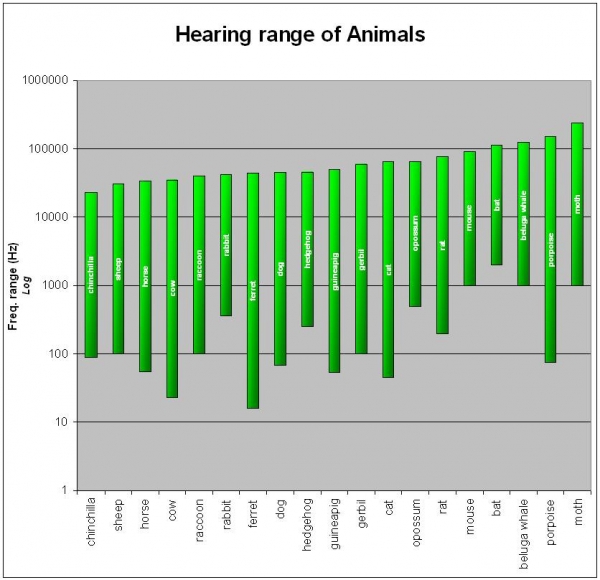
There is evidence that USV is used as a sensitive indicator of subtle emotional and motivational changes in a number of animals. Therefore, USV produced by animals in various conditions could be explored as a non-invasive method for registering the welfare status of an animal.
The most commonly studied species in USV research applications are: mice, rats, hamsters and marmosets.
 Currently known rat and mouse Ultrasonic Vocalizations (USV)
The use of USV to measure the welfare status of an animal can be advantageous in a number of situations:
- at a very early stage of an experiment it is possible to recognize discomfort whereupon pain relief can be administered;
- the effictiveness of the pain relief can be measured (monitored), and if necessary adjusted;
- as a parameter to determine the extend of discomfort or wellbeing;
- as a parameter in behavioral studies;
- as a monitoring system during transport and acclimatization
- as a monitoring system during normal housing conditions.
Click on the movie symbol to see a MPEG movie about the use of ultrasonic communication between rats.
 16 MB Video Clip (copyrights Oxford University - Dr. M. Berdoy)
The full movie and valuable information about the natural life of rats can be found on the Dr. M. Berdoy's website: www.ratlife.org.
Click on the movie symbol to see an AVI movie of a mouse mother responding on an 65 kHz ultrasound call of her pup that is away from the nest.
7 MB Video Clip (copyright Emory University - Liu Lab)
More information can be found on the respective website of Emory University. www.biology.emory.edu/research/Liu/html/index.php
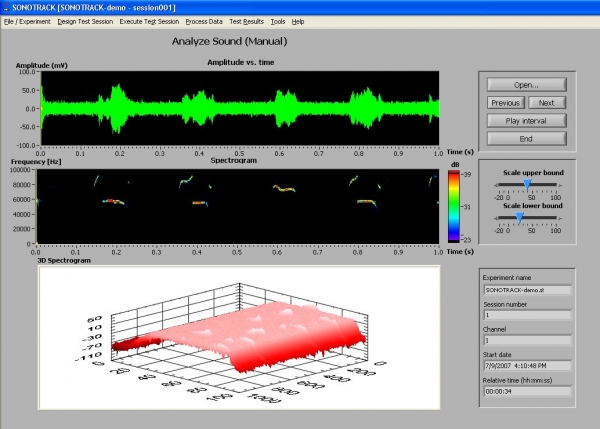
Below a number of USV samples are presented of different species. The samples are converted to normal audio using Time-Expansion technology. The picture on the right presents the amplitude vs. time and the frequency vs. time (spectrogram) of a recording made by Sonotrack which shows a few typical calls of a mouse.
|
Click on the speaker symbol to play a few of the sound files that were recorded and converted to audible signals.
 Sample file #1 (Marmoset sounds) Sample file #1 (Marmoset sounds)
Sample file #2 (Mouse mother and pups)
Sample file #3 (Rat mother and pups)
|
 |
|

|

|